Imagine joining one of Mozambique’s leading banks.
You arrive motivated, highly qualified, and ready to contribute. Your laptop is configured, your email account is active, and your manager is excited to have you on the team. Yet by the end of your first week, you still have not processed a single client transaction independently.
Not because you lack capability or because the technology failed.
Because every decision feels surrounded by regulations you do not yet know how to interpret confidently.
Before executing a single international payment or approving a single trade finance request, you are expected to navigate central bank notices, exchange control regulations, AML and KYC requirements, internal operating procedures, multiple administrative templates, and several layers of approval.
One incorrect document could delay a transaction. A missing requirement could generate regulatory scrutiny. A poorly interpreted instruction could expose the organization to unnecessary risk. So instead of acting, you wait, you ask or you escalate. Eventually, someone with more experience makes the decision for you.
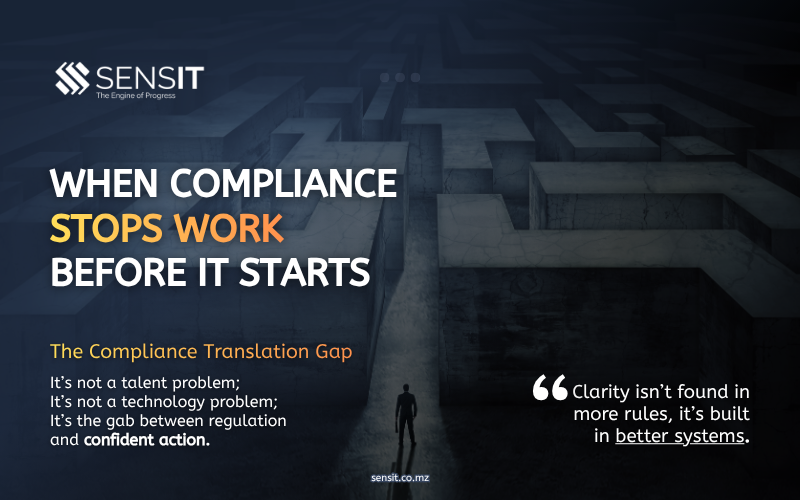
The organization does not have a talent problem and it does not have a technology problem.
It has a translation problem.
At SENSIT, we have started referring to this as the Compliance Translation Gap: the distance between understanding a regulation and confidently applying it in everyday operational decisions.
When organizations fail to translate complex regulatory frameworks into practical, decentralized workflows, onboarding slows, operational latency increases, and expensive human capital spends its first months waiting instead of creating value.
Organizations across the world continue struggling with the hidden operational cost created by increasingly complex regulatory environments:
Research published by Harvard Business Review demonstrates that excessive bureaucracy and expanding management layers create trillions of dollars in lost productivity every year. Bureaucracy quietly behaves like an operational tax, reducing organizational speed without appearing anywhere on the financial statements.
The World Economic Forum has similarly highlighted how excessive regulatory complexity reduces organizational agility, particularly within emerging economies. Instead of investing energy in innovation, customer experience, and growth, organizations become increasingly focused on avoiding mistakes, creating cultures where defense gradually replaces initiative.
The banking sector illustrates this challenge particularly well. The Economist has repeatedly documented how expanding Anti-Money Laundering (AML) and Know Your Customer (KYC) frameworks have fundamentally changed the way financial institutions operate. Compliance has become so demanding that many organizations now prioritize avoiding regulatory penalties over accelerating customer service or empowering frontline decision-making.
When people become afraid to decide
Every organizational system eventually produces a raw, real psychological response.
When new employees enter highly regulated environments without a clear operational roadmap, complexity quickly transforms into hesitation. The fear of making a seemingly minor documentation mistake begins replacing initiative. Employees stop trusting their own judgement because the perceived cost of being wrong feels significantly greater than the benefit of acting quickly.
Instead of resolving issues independently, they begin escalating increasingly routine decisions to supervisors and senior managers. Over time, this creates what we repeatedly observe inside organizations: Approval Reliance. Executives become operational bottlenecks, not because they insist on controlling every decision, but because employees no longer feel sufficiently equipped to make those decisions themselves. The result is organizational latency: files remain on desks awaiting signatures, transactions pause while teams seek clarification and customer requests move slowly through multiple approval layers before finally reaching someone confident enough to say yes.
The organization appears compliant, but its operational velocity quietly disappears.
The Mozambican reality
The Compliance Translation Gap is a fact in Mozambique and when international regulatory frameworks collide with local operating realities, this complexity becomes even more pronounced.
A relationship manager processing an international payment is not simply interpreting internal procedures. They are simultaneously navigating local foreign exchange regulations, commercial documentation requirements, central bank notices, international compliance frameworks, and client expectations.
A single mismatch between supporting documentation and invoice descriptions can delay an entire transaction. An incorrect interpretation of exchange control requirements can create weeks of additional administrative work. The challenge is not simply remembering regulations. It is translating them into practical action while maintaining confidence throughout the process.
During one of our field interviews, an experienced Transaction Banking professional in Maputo summarized this challenge remarkably well:
“Speaking of my specific field, it’s an area that requires a high degree of compliance because we deal extensively with laws and regulations, not only local ones but also international ones. In a way, this ends up becoming bureaucratic. I’m not sure whether it’s bureaucracy or oversight, since it’s related to various things we need to monitor. A new hire enters thinking banking is just about branches, deposits, and ATMs. They have a very narrow view.”
That observation captures one of the largest hidden gaps inside corporate onboarding: new employees are rarely overwhelmed by the volume of information alone. They are overwhelmed because nobody has yet shown them how experienced professionals transform regulations into practical decisions.
Without that translation, compliance begins slowing commercial activity instead of supporting it.
Clients experience repeated requests for documentation, sales conversations lose momentum and transactions are abandoned. Then revenue quietly disappears.
From Individual Experience to Organizational Capability
Every highly regulated organization has people who somehow make complexity look simple.
The senior operations officer who immediately recognizes which document will likely generate questions before the file reaches compliance. The relationship manager who instinctively knows how to explain regulatory requirements in language that clients understand. The compliance specialist who identifies potential issues before they become delays.
Most organizations describe these individuals as experienced employees.
These are people who have spent years translating regulation into operational judgement.
The challenge is that this knowledge rarely exists inside the organization, it exists inside individuals.
When one experienced banker leaves, they do not simply take years of experience with them.
They take mental checklists, decision shortcuts, risk recognition patterns, client communication techniques, operational confidence.
The organization then begins rebuilding that knowledge from the beginning. Again.
Traditional corporate onboarding often assumes that regulations alone are sufficient to prepare new employees. In practice, regulations explain what must happen, but experienced people know how it actually happens.
Rather than asking organizations to continuously train around complexity, we begin by identifying where operational excellence already exists. We observe the professionals who consistently navigate compliance with confidence; identify the practical decisions they make almost instinctively; document the mental models, judgement patterns, communication approaches, and operational sequences that distinguish them from everyone else. Then we transform those behaviours into repeatable organizational systems that new employees can learn in weeks instead of years.
Rather than allowing operational confidence to remain dependent on individuals, organizations begin building institutional capability that survives staff turnover, accelerates onboarding, and increases execution quality across the entire business. Because you cannot train people out of a broken system. You have to improve the system that teaches them how to work.
The Competitive Advantage Hidden Inside Compliance
Technology will continue improving. Artificial intelligence will automate increasingly complex administrative tasks. Regulatory environments will continue evolving. Yet one reality is unlikely to change: organizations that outperform their competitors will not simply be those with the most sophisticated compliance systems.
They will be the organizations that translate complexity into clarity faster than everyone else, because regulations by themselves rarely slow organizations. The inability to transform those regulations into confident everyday decisions does.
Curious what this looks like inside your Organization?
If your teams spend more time interpreting compliance requirements than serving clients, there may be operational friction hidden inside your onboarding systems rather than your people.
Schedule an Executive Sync with SENSIT.
Together, we’ll map where compliance is slowing execution and explore how hidden operational knowledge can become scalable organizational capability that strengthens performance across your organization.