We live in a world where information has never been cheaper, faster or more accessible.
And yet, inside many organizations, people have never been more confused about what they’re supposed to do next.
Imagine you’re driving from Maputo to Pemba and every few minutes someone in the car gives you a different instruction. One person says turn left while another says continue straight. Someone else asks you to stop in Xai-Xai before changing their mind entirely, when you’ve already spent 30 minutes offloading everything from the car.
We know, it feels like a complete mess of a travel nightmare, right?
This unfortunately happens a lot. Within organizations, the way information flows from one department to another, or from top management to the people on the ground floor, usually has nothing or little to do with the quantity of information, but with the quality and flow of it.
People do not feel informed, but overwhelmed and overloaded. The problem does not lie with the people, but with the systems that govern the correct usage of the available information. These systems do not allow for confidence and efficiency to develop as per the intention they were built from.
A lot of leaders tell us “People just don’t communicate“.
In reality, many businesses suffer from the opposite problem: communication overload. Emails, WhatsApp groups, voice notes, teams messages, calls, follow-up calls, follow-up messages asking whether the previous message was seen.
Information moves constantly, but work doesn’t.
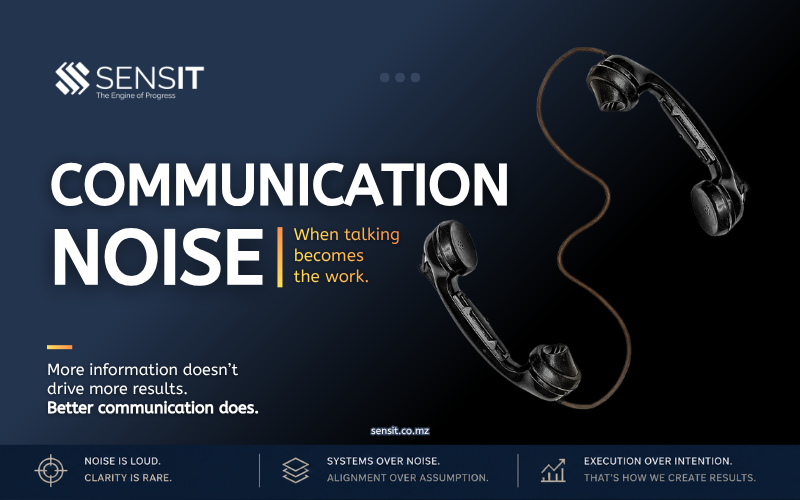
This phenomenon is called communication noise: when the volume of information exceeds a team’s ability to identify what action is required, when that action is required, and what information actually matters.
When this happens, communication stops being an element that supports execution and actually fights against it. And that feeling is not just frustrating. It’s expensive.
Research estimates that poor communication costs organizations approximately $1.2 trillion annually through lost productivity, misunderstandings, operational inefficiencies, and project delays.
To put that into perspective, that figure is roughly fifty times larger than Mozambique’s entire GDP.
At the same time, business leaders consistently report that effective communication practices directly contribute to winning new business, improving customer retention, and increasing organizational performance.
The conclusion is uncomfortable but simple: communication is not a soft skill, it’s one of the main ways in which we gain or lose business. So if you can’t control the outcome directly, you control the input – the system behind it – and how you operate it either accelerates execution or slows it down.
One of the places where communication noise appears most frequently is in client interactions.
In an effort to be helpful, clients often provide everything: historical context, future ambitions, current frustrations, competing priorities, supporting documents, emails, and a call to explain the email.
The information itself is not the problem. The problem is that not all information carries the same operational value at the same moment to the same people.
As a result, teams spend valuable time trying to answer the same questions that should never consume their energy:
“What exactly are we supposed to focus on now?”
The mental capacity of talent that should be directed toward innovation, problem-solving, and customer value becomes consumed by the exhausting work of interpreting direction and intent.
In Mozambique, this challenge has its own unique flavor, because the reality of working with clients, regulators, and stakeholders often means navigating multiple layers of communication before any actual work can begin.
A compliance department requests documents that were already submitted three times. A meeting is scheduled to discuss the meeting that happened to prepare for the meeting that will eventually make the decision.
None of these situations exist because people are unwilling to communicate. They exist because communication itself has become work.
In order to create generational impact as an organization in this market it will not be through who has the most meetings, the longest emails, or the busiest WhatsApp groups.
It will be through learning how to say less, decide faster, and move more. Because for our clients, success depends less on what people know and more on what they are able to do with what they know.
A client of ours was dealing with a problem that, on the surface, looked like a communication issue.
But when we stepped in, it was something more structural.
- Information was not flowing in a way that allowed execution to happen cleanly across teams. Every department was “doing their part”, but the system between them was creating friction at every step.
- Requests were being repeated because no one was fully sure what had already been approved.
- Teams were responding to messages, but not necessarily to the same version of reality.
- And by the time information reached customer-facing teams, it had already been translated, reinterpreted, and sometimes contradicted.
The result was predictable: delays in execution, rising internal frustration, and a customer experience that felt inconsistent and unreliable.
Instead of adding more communication tools or more reporting layers, we focused on something simpler. We changed how communication was structured at the point it is created.
We introduced a shared way of writing and sending updates across departments – not to make people “communicate more”, but to make sure every message immediately answered three things:
- What are we doing?
- When does it need to happen?
- What context changes how it should be done?
At the same time, we removed unnecessary translation layers between back-office and front-office teams, so that customer-facing decisions were no longer being rebuilt from scratch internally.
The shift was not dramatic in appearance, but it was immediate in effect.
Meetings became shorter because people were no longer trying to reconstruct context. Teams started resolving requests in fewer steps because ownership was clearer from the start, and internally, something subtle but important changed: people stopped feeling like they needed to “interpret” everything before acting on it.
Within weeks, the organization reported a noticeable increase in confidence around communication clarity, and a sharp reduction in back-and-forth across departments. More importantly, teams stopped spending energy on figuring out what was meant – and started spending it on execution.
That is usually where the real cost of communication noise shows up. Not in what is said.
But in everything that needs to be re-said before anything can move forward.
Sometimes, the biggest problem in an organization isn’t that people aren’t communicating.
It’s that everyone is and no one is getting very much done.
Curious about how these methods could help your team?
👉 Request an Executive Sync and we will share the exact framework implemented on the training.