

There is something about leadership that is deeply underestimated.
Most leaders understand reciprocity when it works in their favor. If you support your team, they will probably support you back. You invest in people’s development, they will often become more engaged. You bring trust to the table, they are more likely to trust you back.
This idea is not controversial. In fact, it is one of the most accepted principles in leadership and organizational psychology.
But there is another side of reciprocity that we don’t think gets noticed: reciprocity doesn’t just work when you’re nice. It works when you’re not, and sometimes, it works even harder.
We’ve spend a lot of time inside organizations trying to understand why certain behaviors persist. Managers say that they’ve tried everything, and people just don’t listen or that they say “Esse pessoal é confuso!” or “São teimosos“. The communication problems never seem to disappear, ownership feels low and teams continue to be defensive.
The main consequence of it is that leaders feel like they’re carrying the organization while employees feel like they’re surviving it.
Over time, we’ve started noticing a pattern:
What is labelled as “people problems” are, in many cases, reciprocal responses. Not because employees are difficult. Not because leaders are bad. But because human beings brains respond to the environments they experience.
In other words, people don’t just reciprocate generosity, they reciprocate treatment.
Reciprocity as a signal for communication, ownership, culture and trust
Communication is usually where this becomes most visible. Leaders often say that communication is broken in their organization, but communication is rarely broken in isolation. It is usually consistent with what people have learned is safe. If leaders communicate vaguely, teams learn to communicate vaguely. If decisions are made without explanation, people begin to assume explanation is not required. If feedback only appears when something goes wrong, then feedback becomes something to avoid rather than something to use.
What looks like a communication problem is often a learned response to a communication environment.
The same pattern shows up in ownership. If people experience unclear expectations, they start reducing personal responsibility. If they experience shifting priorities, they stop committing deeply to any single direction. If they experience pressure without context, they begin to protect themselves instead of pushing for outcomes. From the outside, this can look like disengagement. But internally, it is often just adaptation.
This is where reciprocity becomes uncomfortable for leadership, because it stops being about intention and starts being about impact. A leader may intend to create accountability, but if what people experience is pressure without clarity, what gets returned is hesitation or defensiveness. A leader may intend to create urgency, but if the experience is constant urgency without prioritization, what gets returned is fatigue. A leader may intend to create high standards, but if those standards are delivered through criticism without support, what gets returned is avoidance.
None of this happens because people are unwilling to perform. It happens because organizations are systems, and systems are constantly teaching people how to behave inside them. Every interaction communicates something. Every meeting reinforces something. Every decision signals something about what matters and what doesn’t. Over time, these signals stop being individual events and start becoming patterns. And those patterns eventually become the culture.
In our experience, one of the biggest mistakes organizations make is assuming that culture is something leaders create through values on beautiful frames on the walls, team meetings, or engagement initiatives like team buildings.
Culture is created through repeated experiences, which create reciprocal behaviors.
Two organizations can have the exact same values written on the wall and produce completely different cultures. One organization says, “We value transparency”, and leaders explain decisions, invite questions, and communicate openly. The other organization says, “We value transparency”, but information travels through rumors, hierarchy, and assumptions. The words are identical, but the experiences are entirely different.
And people always reciprocate the experience.
Trust inside organizations is often misunderstood. Leaders sometimes try to “build trust” as if it is something that can be communicated or requested. But trust is rarely built in that way. It is built through repeated exposure to reliability, clarity, and fairness. When those experiences are consistent, trust emerges almost naturally. When they are inconsistent, people begin to withdraw, not as a decision, but as a form of protection.
Over time, what starts as small behavioral adjustments becomes structural. People stop speaking up, escalating issues early, challenging assumptions and investing more than what feels necessary. From leadership’s perspective, it often appears as a sudden cultural decline, when in reality it is the accumulation of many small reciprocal exchanges that have been reinforcing each other for months or even years.
This is why we increasingly question whether many organizational problems are actually motivational problems at all. Low engagement, poor communication, lack of ownership, resistance to change, even silence in meetings, these are often described as individual issues. But they can just as easily be understood as system outputs. They are what happens when people are consistently responding to the environment they are in.
In this context, the more useful leadership question is rarely “Why are people behaving this way?” and more often “What are people responding to?”
Because people are always responding to something. And whatever they respond to, they will eventually mirror back.
This doesn’t reduce leadership responsibility to perfection. What it does is increase the weight of awareness, because leadership is not only about what is said or intended. It is about what is experienced repeatedly, this becomes the material that behavior is made of.
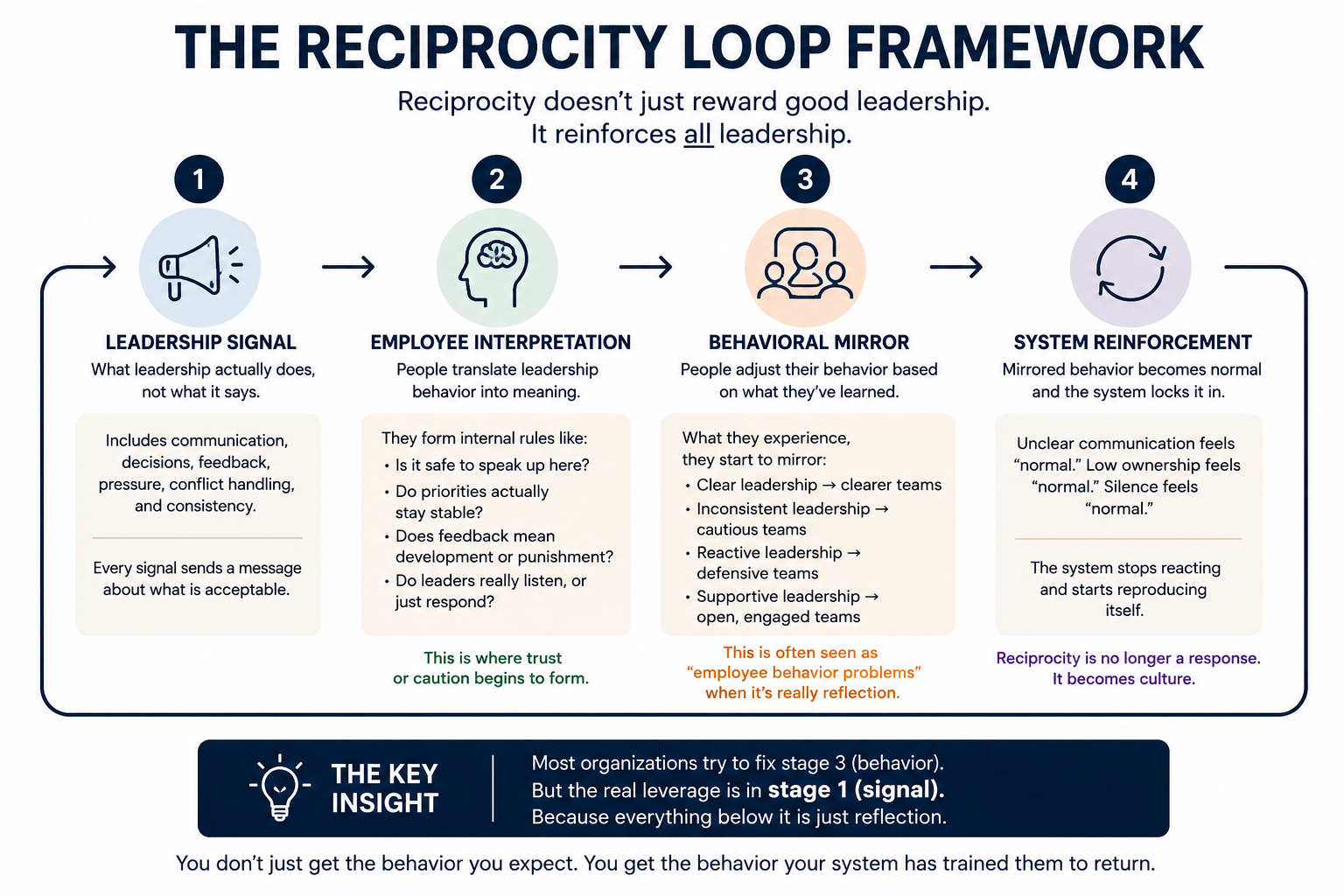
The Reciprocity Loop Framework
At SENSIT, we describe reciprocity inside organizations as a loop, not a value because what matters is not whether reciprocity exists, it is what direction it is moving in, and what it is reinforcing.
There are four stages in the loop:
1. Leadership Signal
This is what leadership actually does, not what it says.
It includes things like communication clarity, consistency of decisions, how feedback is delivered, how pressure is applied, and how conflict is handled. Most organizations underestimate this stage because it feels normal internally. But to the system, it is the original input.
Every signal sends a message about what behavior is acceptable.
2. Employee Interpretation
This is where people translate leadership behavior into meaning. Not consciously, but practically.
They start forming rules like:
- “Is it safe to speak up here?”
- “Do priorities actually stay stable?”
- “Does feedback mean development or punishment?”
- “Do leaders really listen, or just respond?”
This stage is where trust or caution begins to form. It is also where most misunderstandings in organizations start.
3. Behavioral Mirror
This is where reciprocity becomes visible. Employees begin adjusting their behavior based on what they have learned from the system.
- If leadership is clear, teams become clearer.
- If leadership is inconsistent, teams become cautious.
- If leadership is reactive, teams become defensive.
- If leadership is supportive, teams become more open.
This is the stage most leaders label as “employee behavior problems”, when in reality it is reflection.
4. System Reinforcement
This is the most dangerous stage, because it stabilizes everything.
Once mirrored behavior becomes normal, it starts reinforcing the original leadership environment. Now unclear communication, low ownership, silence feel “normal”. The system stops reacting and starts reproducing itself.
At this point, reciprocity is no longer a response, it becomes culture.
Here’s a tip:
Most organizations try to fix stage 3 (behavior), but the real leverage is in stage 1 (signal) because everything below it is just reflection.
Reciprocity is not just a leadership principle about kindness or influence. It is a systems principle about repetition. And once you see it that way, leadership stops being about managing behavior and starts being about shaping the conditions that behavior will inevitably reflect back.
Are you seeing patterns of negative reciprocity within your organization?
👉 Request an Executive Sync for our team to help you map out the exact signals behind it, with custom solution for your problems.